Houston, right now.
Flood alerts, bayou levels and resources across Greater Houston.
This map needs WebGL, which your browser has turned off.
Immediate Houston Flood Triage
Bayou Gauges
Live USGS & Harris County stream stages, rise rates, and official out-of-bank thresholds.
Check gauges → HyperlocalZIP Code Triage
Enter your Houston ZIP code for watershed notes, typical drainage patterns, and local guides.
Lookup your ZIP → Verified LinesEmergency Phones
Tap-to-call directory: 911, Coast Guard, CenterPoint Outages, Houston 311, and Red Cross.
Open phone desk → Official FEMA2D Floodplain Map
Search any Houston street address to check official FEMA 100-yr, 500-yr, and regulatory floodways.
Open parcel map →How Houston Flooding Actually Works
Why your street is engineered to be a temporary holding bathtub, why bayous act as the regional drain, why just 12 inches of water turns a sedan into a floating boat, and how sunken underpasses fill into 9-foot death traps in 15 minutes.
“The Kitchen Faucet Mode”
The Everyday Analogy: Like running your kitchen sink faucet normally. The drain pipe under the sink effortlessly swallows every drop as fast as it lands.
Houston neighborhood storm pipes are sized for ~1.5 inches of rain per hour. Rain enters the curb grates and gravity pulls it straight into the 25-foot bayou trench (currently only 30% full).
Streets remain dry or show minor curb trickles. Cars travel safely, driveways are bone-dry, and the house slab sits 18+ inches safely above water.
“Street Bathtub Mode (By Design!)”
The Everyday Analogy: Like turning a commercial firehose on full blast into that same kitchen sink. The drain pipe is flowing at 100% capacity, but the basin fills up 6 to 12 inches deep while waiting for gravity to catch up!
Houston is flat gumbo clay. Civil engineers intentionally designed your street with 6-inch curbs to act as a holding bathtub during sudden downpours. Storing 6–12 inches of water between the curbs keeps it safely out of your living room!
Do NOT drive through it. The bayou still has plenty of capacity (65% full). As soon as the cloudburst tapers off, the street bathtub drains completely empty in 30–45 minutes.
“The Plugged Drain & Backwater Lock”
The Everyday Analogy: Putting the rubber stopper in the bathtub drain. Once the 25-foot bayou trench reaches 100% rim level, the river water pushes backward into the storm pipe. The drain is completely plugged!
Gravity storm pipes cannot discharge when the bayou surface is higher than the pipe outfall. Street grates stop draining. Water climbs past the curbs, floods driveways, submerges parked vehicles, and approaches the 1st-floor concrete slab.
Move vehicles to parking garages or elevated expressway ramps immediately. Photograph waterlines, stage emergency go-bags, and review the Waterline Tear-Out Matrix below if water crosses the threshold.
Sedan Floats (1,500 lbs Displacement)
At 12 inches of water, a standard compact car (Civic, Corolla, Model 3) begins to float. Each foot of water displaces about 1,500 pounds of vehicle weight. Tires lose friction with the pavement and steering stops working completely.
Water In Street Bathtub Gutter
At 12 inches, water has topped the 6-inch street curb and is creeping up the driveway apron, but remains safely 6 inches below typical Houston 1st-floor concrete slabs (+18″).
The 15-Minute Underpass Bowl Trap
Why sunken Houston freeway underpasses fill into 9-foot submerged lakes in under 15 minutes—even while regional bayou gauges are still green!
Sunken Underpass is Completely Clear
The Situation: The underpass is 14 feet below surface street grade. The small electric lift station pump at the bottom (capacity ~500 gallons/min) easily handles normal light rain.
Pavement is wet but completely clear. Warning signs are dark. Drivers accelerate through the dip at 60 mph without a second thought.
Harris County Flood Warning System gauges read 10–15% bed capacity. Stream levels are completely normal.
SUV Floats Off Road While Bayou Gauges Are Still Green
The Deadly Disconnect: A 4 in/hr cloudburst drops 108,000 gallons of water per acre per hour across the freeway ramps. Both slopes act as a giant funnel, channeling millions of gallons into the bottom bowl. The 500 GPM pump is overwhelmed 200-to-1 in 600 seconds!
Water reaches 3.5 to 4 feet in the dip. Full-size pickup trucks and SUVs lose tire traction and float like corks. Water reaches air intake vents, instantly hydro-locking engines.
The nearest bayou gauge is still reading 🟢 35% Full! Big bayous take 1–3 hours to fill up. Sunken underpasses fill in 10 to 15 minutes. Never trust a green river gauge to judge a sunken road.
Looking Like a 3-Inch Puddle While Hiding a 9-Foot Lake
The Headlight Mirror Trap: Silt-heavy muddy floodwater forms a flat horizontal surface spanning from ramp to ramp. At night, headlight beams bounce off the water mirror at a low grazing angle, making 9 feet of brown water look IDENTICAL to flat, wet asphalt!
Vehicles plunge in at speed, nose-diving into 9 feet of water. Water pressure against the doors exerts over 800 pounds of force, pinning occupants inside while the vehicle fills to the ceiling.
If you hit rising water: Unbuckle instantly and roll power windows down in the first 30 seconds before electrical systems short out. If windows won't open, use your center-console glass punch on a side window.
Flash Flood Awareness, Night Visibility & 15-Minute Prevention
Essential survival physics and homeowner protocols for Houston's high-speed tropical rain events.
Why Houston Flash Floods Faster Than Almost Anywhere in the U.S.
People often compare flash floods to Death Valley (`1–3 warnings/yr`), where bare bedrock funnels 0.5 inches of rain into narrow slot canyons.
Houston (`15–25+ flash flood warnings/yr`) is the exact opposite physical trap: 3,000 square miles of impervious gumbo clay and asphalt hit by warm tropical Gulf air masses dropping 4 to 6 inches of rain in a single hour.
Driver & Night/Flashlight Visibility Rules (The 60-Second Protocol)
- The Night Glare Illusion: Headlight beams reflect off brown silt water at a flat angle. Never enter water if you cannot distinctly see the white/yellow painted lane lines or the top of the concrete curb.
- Console Kit (Tactical Flashlight + Glass Breaker): Keep an emergency high-lumen flashlight with a carbide window-punch tip in your center console (NOT in the trunk or glove box where water will pin it shut).
- The 30-Second Rule: If your car ever stalls in water: Unbuckle immediately and roll power windows down in the first 30 seconds. Once water reaches the door sills, outside pressure locks doors shut and electrical circuits short out.
Homeowner 15-Minute Flash Flood Prevention Checklist
- Rake Your Curb Storm Grate: Clear pine needles, wet leaves, and trash cans 10 feet back from the curb inlet. A clogged grate backs up your street bathtub 3x faster into yards.
- Move Cars to the Driveway Crown: Never leave parked cars in the curb gutter ("the street bathtub"). Move them onto the highest point of the driveway apron or garage.
- Main Breaker Panel Flashlight: Hang a charged flashlight directly beside your main electrical breaker. Lift ground-floor electronics, surge protectors, and power strips 18 inches off the floor. Never step into garage water with the main breaker energized.
Houston’s Notorious 15-Minute Flash-Flood Underpass Bowls
These sunken road depressions routinely submerge 6 to 12 feet deep within 15 minutes of cloudburst rainfall, hours before bayous crest:
Always monitor Houston TranStar camera feeds and exit onto elevated surface feeder streets before entering sunken freeway trenches during active cloudbursts.
Bathtub Street vs. Bayou Hydraulic Profile
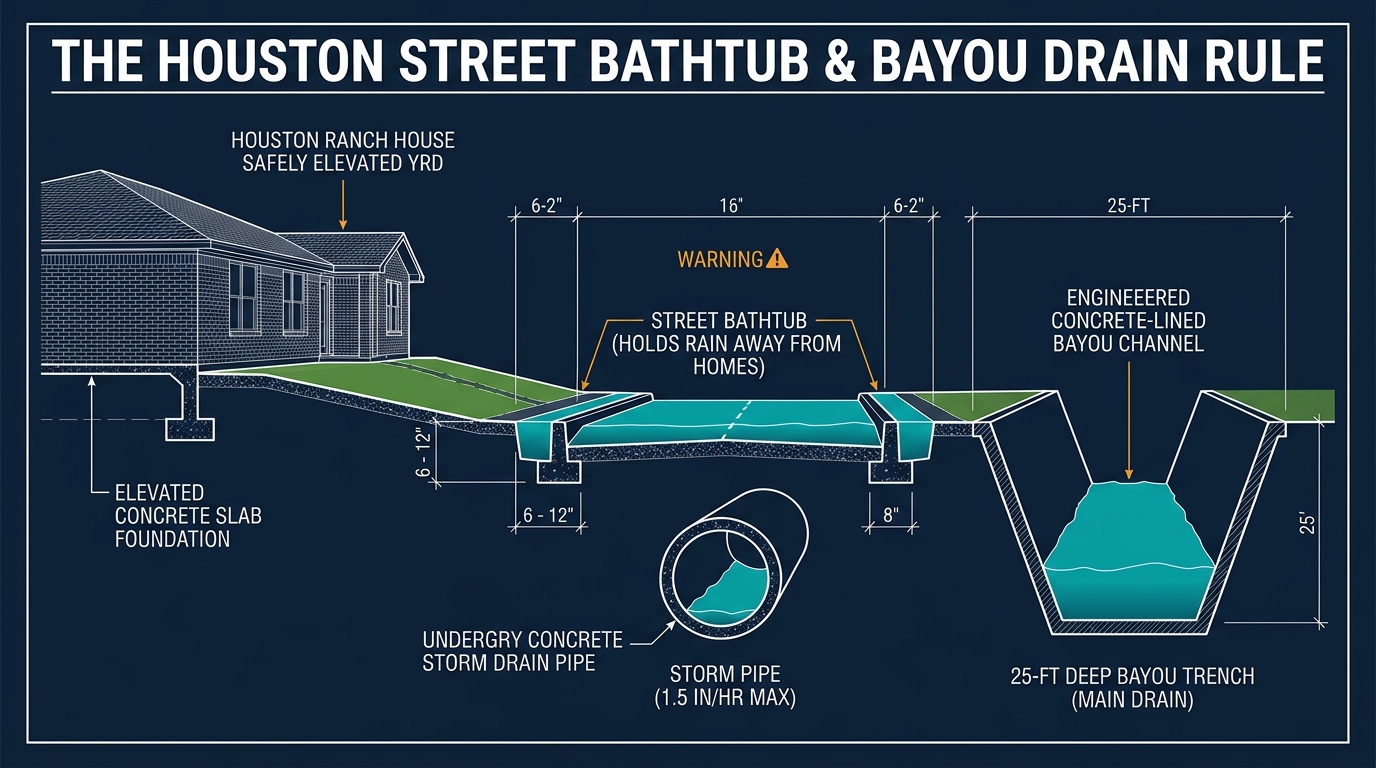
Harris County design criteria: Streets are engineered with depressed gutter inverts to detain up to a 100-year storm event without water breaching finished floor elevations.
Real-Life Flood Depth Scale: Curb, Car & Home
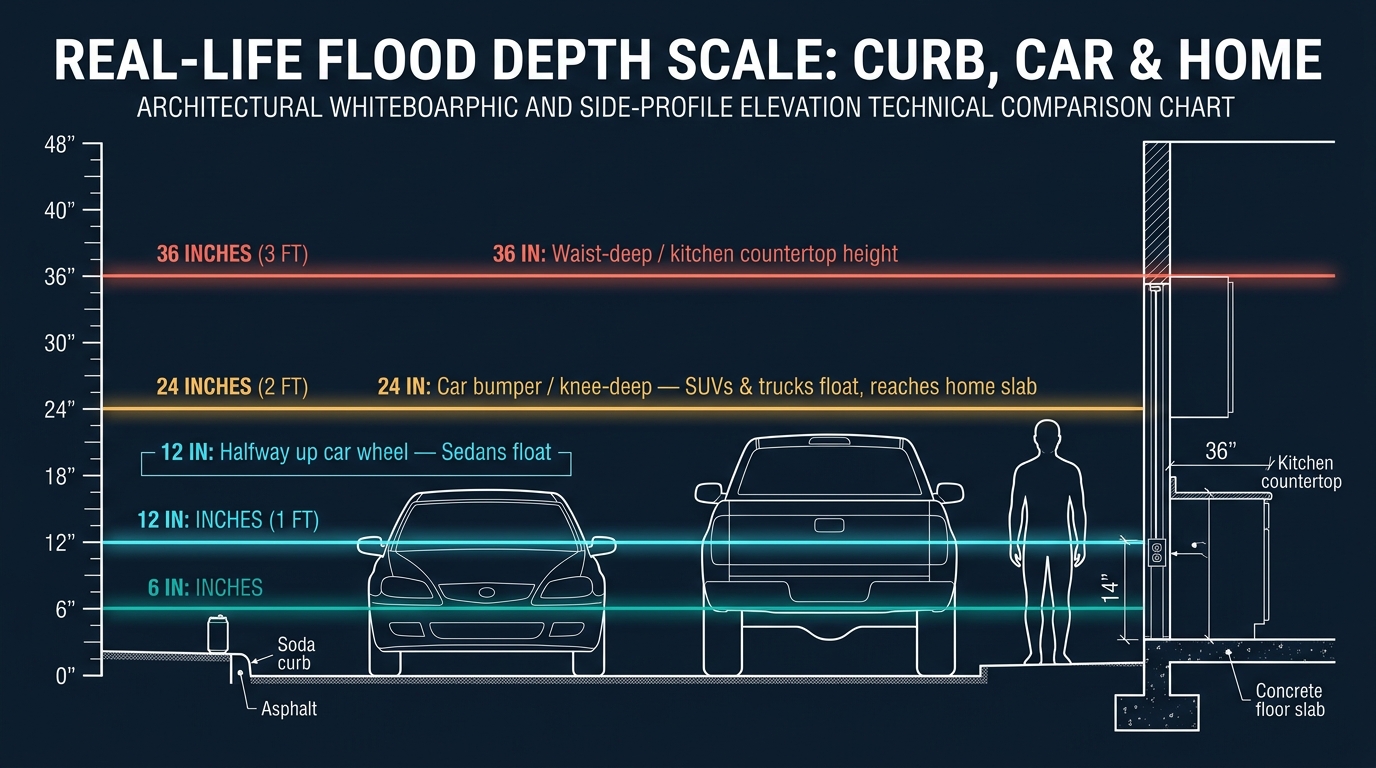
Buoyant force equals displaced water weight: A submerged truck cabin displaces ~65 cu ft of water (over 4,000 lbs of upward lift), breaking traction with pavement.
The 15-Minute Flash Flood: Underpass Bowl Trap
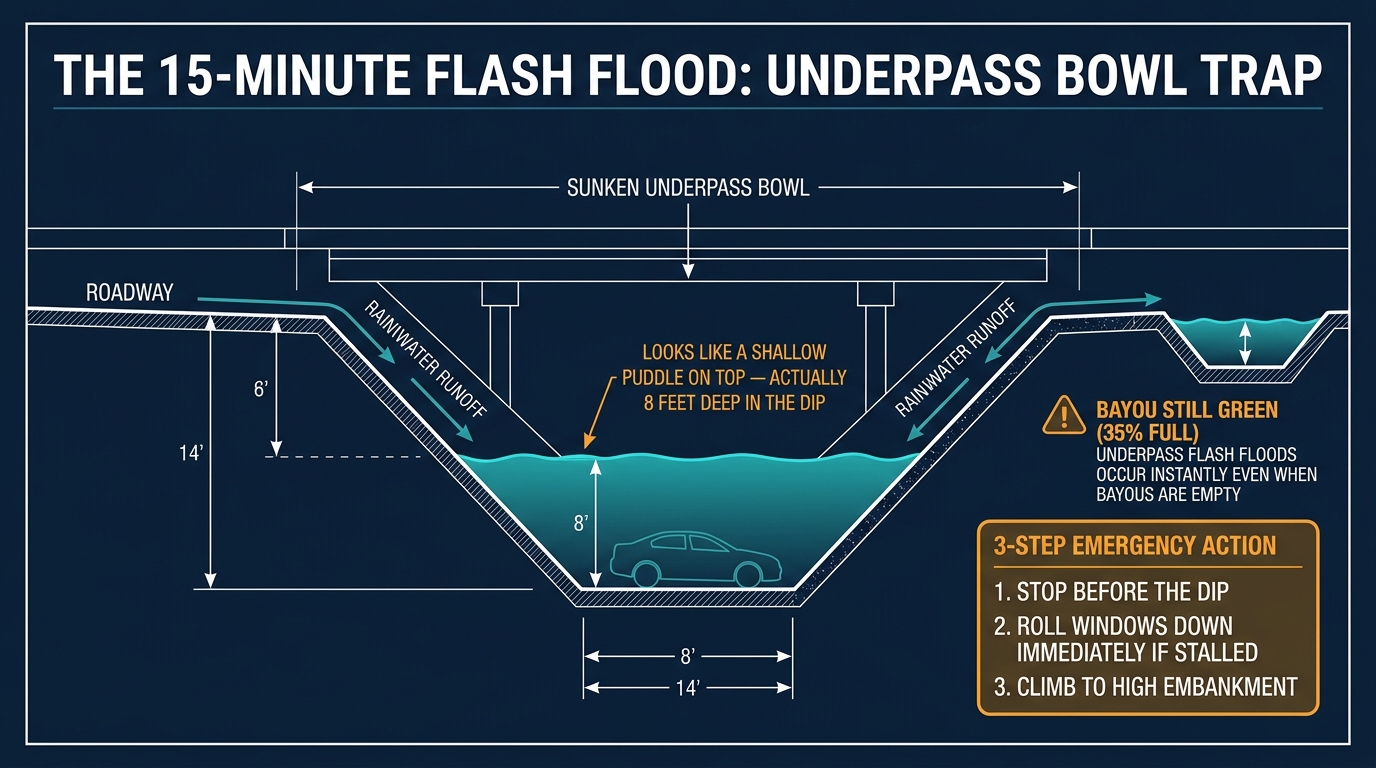
Funnel effect: Sunken underpasses collect highway runoff faster than small pumps can lift. Silt floodwater forms a flat mirror that hides a 9-foot drop.
Flash Flood Awareness, Night Visibility & 15-Min Prevention
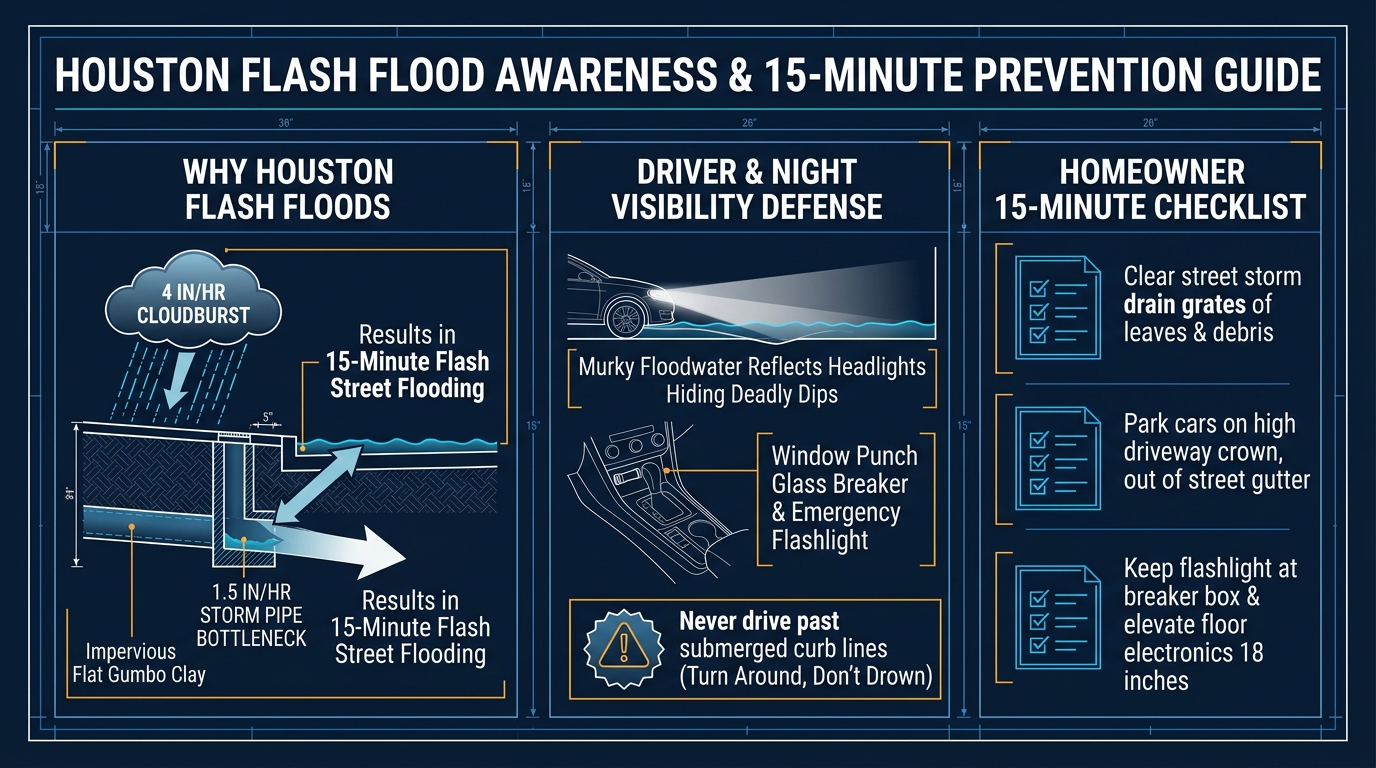
Houston flash floods 15x faster than arid deserts due to flat clay, 3,000 sq miles of concrete, and 4–6 in/hr Gulf cloudbursts.
Houston Hydraulic Principles Every Resident Should Know
- ASCE 24 Slab Elevation Rule: In Harris County post-Harvey regulations, all newly built or substantially improved structures must have their lowest finished floor elevated at least 24 inches above the 500-year base flood elevation.
- The “Tailwater Lock” Physics: When a bayou surface climbs higher than the invert of a storm drain pipe, backpressure prevents water from discharging. Even with clean, unobstructed grates, street water cannot drain until the bayou crests and recedes.
- Why Street Pumping Fails: Improvised trash pumps placed in flooded streets cannot out-pump an active 2-inch-per-hour cloudburst, which drops approximately 54,000 gallons of water per acre per hour.
Key Houston Watershed Stages
Worst Storm Depth: 1.5–3.5 ft in 1st-floor homes (Harvey)
Worst Storm Depth: 3–6 ft on Allen Pkwy & low banks
Worst Storm Depth: 3–8 ft in underpasses; 1–3 ft low blocks
Worst Storm Depth: 2–4.5 ft in ground-floor apts & feeders
Worst Storm Depth: 1–3 ft in low Creekside subdivisions
Worst Storm Depth: 2–4.5 ft in downstream release zone
Worst Storm Depth: 2–6 ft in 1st-floor riverfront homes (Harvey & May 2024)
Where are you in the storm?
Select your current situation for step-by-step guidance, essential checklists, and direct tools.
First hour
- Shut off power from a dry location, never stand in water to flip breakers.
- Photograph the waterline and every room before you move or discard anything.
- Pull wet carpet, pad, and mattresses as soon as it is safe.
- Do not start a flooded car to see if it runs.
- Never drive into flooded roads or underpasses, depth hides and water can sweep the car.
- Call your flood insurer the same day you can, open the claim before heavy demo when possible.
Water in house Cleanup
- Pump out standing water and extract before finish demo when power and structure allow.
- Cut out wet drywall and wet insulation without delay once documented.
- Flood-cut drywall high enough to clear the wet zone (often about 2-4 ft), then open the cavity to air.
- Run air movers and dehumidifiers until framing moisture is in range, not just a few box fans.
- Buy or borrow a moisture meter and check studs before closing walls.
Power CenterPoint
- Shut off power from a dry location, never stand in water to flip breakers.
- Run generators outdoors only, never in a garage, breezeway, or near open windows.
- Do not run a generator in an area that could flood; move it to high, dry ground first.
- Replace submerged outlets, breakers, and appliances, do not dry and reuse flooded electrics.
- Use CenterPoint's official outage map, not neighborhood rumor, for restoration status. CenterPoint
Car Flooded car
- Do not start a flooded car to see if it runs.
- Check the air filter for moisture before anyone turns the key; if damp, tow, do not start.
- Photograph the exterior waterline and cabin water height before tow or cleanup.
- Call comprehensive auto coverage and ask where they want it towed, save tow/storage receipts.
- Turn Around Don't Drown, especially at Energy Corridor and other below-grade underpasses.
Mold Mold
- Do not rely on bleach to kill mold inside porous studs, drywall, or insulation.
- Do not bleach studs and call the cavity clean, remove wet porous material and dry the framing.
- Never mix bleach with ammonia or other cleaners while remediating. ABC13
- Do not run HVAC until ducts and the system are checked after contaminated floodwater. UTHealth
- For significant mold, use a TDLR-licensed mold assessor (separate from remediator when required). TDLR
Claim Claim packet
- Know whether you have NFIP flood coverage vs homeowners, most Houston home policies exclude flood.
- Build a room-by-room contents inventory with photos, model/serial numbers, and ages/values.
- Give the adjuster organized evidence packets, not a verbal story.
- Apply for FEMA Individual Assistance when a declaration exists even if you have insurance.
- Separate flood claim (flood policy) from wind/roof claim (homeowners), do not mix peril stories. TDI
Hire Hire
- Do not sign large deposits, assignments of benefits, or claim-control papers with door-knockers.
- Get multiple written estimates; verify insurance, references, and permits before work starts.
- Be wary of roofers who knock after storms offering to file the claim for you.
- Check TDLR licensing for mold work before paying. TDLR
- Demand a written scope, equipment log, and moisture readings from water-restoration firms.
Waterline Action & Tear-Out Protocol
Standard operating procedures for Houston slab foundations based on flood depth.
| Flood Depth | Drywall & Framing Cut | Flooring & Cabinets | Electrical / HVAC | Critical Rule |
|---|---|---|---|---|
| Level 1: Minimal Damp Slab / Seepage (< 1") | Keep intact if moisture < 15%. Remove all baseboards immediately so air movers reach bottom plate framing. | Tile/vinyl can be disinfected. Carpet pad acts as a sponge on slab and must be pulled. Carpet can sometimes be saved if water was clean rain. | Safe if water stayed below outlet boxes (usually 12–16" up). Turn off floor-level power strips. | Crucial: Do not leave baseboards on. Trapped moisture behind vinyl or painted MDF baseboards rots the bottom plate within 72 hours. |
| Level 2: Moderate Over Baseboards (1" – 12") | 2-Foot Flood Cut minimum (cut at 24" line). Pull all wet batt insulation behind it. Spray framing with EPA-registered antimicrobial (not bleach). | Total carpet & pad removal. Laminate, engineered hardwood, and vinyl plank over pad will warp and must be pulled to expose slab. | Submerged outlets and switches are ruined by silt/corrosion. Cut power at main breaker before touching any wet room outlets. | Crucial: Do not start a 'bleach party'. Bleach cannot penetrate porous wood framing and releases hazardous chlorine fumes in closed rooms. |
| Level 3: Severe Knee to Waist (12" – 24") | 4-Foot Flood Cut (standard sheet height). Strip batt insulation up to 48". Leave wall cavities completely open to industrial air movers. | 100% floor covering removal. Lower kitchen & bath vanity cabinet boxes (particle board/MDF) dissolve and cannot carry countertop weight. | All outlet boxes, wiring splices, and crawlspace runs compromised. Water heater and furnace burners submerged = mandatory replacement. | Crucial: Never turn on the HVAC system. If ductwork, floor returns, or air handler took bayou water, running the blower blows toxic mold spores throughout the house. |
| Level 4: Catastrophic Waist Deep+ (24"+ / Submerged Panel) | Strip drywall and insulation to ceiling. Exterior sheathing inspection required. Daily moisture logs required for insurance structural payout. | Complete muck-out to raw slab or subfloor. Built-in appliances, appliances motors, and interior doors warped beyond realignment. | If main breaker panel or meter base was submerged, CenterPoint will NOT restore power without a licensed electrician permit/release. | Crucial: Separate the mold assessor from the remediation contractor. Under Texas TDLR law, the company that assesses/tests mold cannot be the contractor who cleans it. |
Interactive Flood Tools & Calculators
22 purpose-built utilities for Houston homeowners, renters, drivers, and operators.
Live Monitoring, Alerts & Mapping
Live bayou gauges
Live USGS stream readings for Houston-area bayous, in your browser. Nothing stored, nothing guessed.
Houston flood map
Neighborhoods, bayous, USGS gauges, and the official FEMA flood hazard layer. Not a survey.
ZIP / neighborhood triage
Enter a Houston-area ZIP. Get bayou notes, area articles, and live-check links.
Conditions-changed signup
Email intent form. Official OEM / NWS alerts stay the source of truth.
Evacuation maps
Hurricane zip zones are not an inland bayou flood plan. Official maps and TranStar.
Houston flood timeline
Fifty years of flood and storm declarations tied to the bayou guides that help this week.
Harris County disaster history
Every federal declaration since 1973, live from OpenFEMA, with individual-aid flags. Past aid is not a promise.
Immediate Emergency & Shelter
Phones
Critical Houston flood numbers. Tap to call. Verified lines only.
Do not start that car
Step flow: leave it off, shoot the waterline, open the claim, then tow.
Shelter intake script
Printable questions: pets, accessible beds, intakes tonight, ID. Then verify live.
Renter / landlord mode
Toggle checklists and notification templates. Link the renters-landlords articles.
Mutual-aid board
Curated verify-live channels. No fake Facebook groups. Ready Harris, 211, Red Cross, West Street.
Offline / print pack
Who to call, first 24 hours, document before demo. Built for a printer.
Claims, Recovery & Contractor Vetting
Claim packet generator
Room checklist, photo prompts, contents lines. Print or download JSON/CSV.
Contractor scam check
Hard-no patterns plus deep links to TDLR, the Texas AG, and TDI. We do not live-verify licenses.
Vet a restoration contractor
Twelve questions, red-flag answers, and a bid comparator. Education, not a referral.
Dry-out timer
A week of drying checks with “call a pro if” gates. Saves on this phone.
FEMA / SBA deadline calendar
Typical reminder math from the dates you enter. Always verify on DisasterAssistance.gov and SBA.
Emergency contractor forms
Boilerplate scope, payment, and sign-off forms. Not legal advice. Get a Texas attorney review.
AI prompts for flood help
Copy-paste prompts for claims, FEMA aid, vetting crews, and cleanup. Each links to the desk article.
Debris set-out
How Houston debris piles usually work, plus 311 and county notice links. No invented pickup days.
Your Part of Houston: 13 Watershed Guides
Houston flooding is dictated by your specific bayou or reservoir pool, not broad citywide forecasts.
Common Mistakes That Cost Houstonians Thousands
Hard lessons from Harvey, Tax Day, Imelda, and Beryl.
Bleach does not reliably kill mold in porous wood; remove wet materials and dry framing.
Cranking can hydrolock the engine; tow and inspect first.
Need continuous air movers/dehumidification and moisture readings before closing walls.
Most homeowners policies exclude flood; you need NFIP or private flood.
FEMA IA is limited assistance and cannot duplicate insurance; still apply when eligible.
Pressure to sign AOB/claim control is a classic post-storm scam pattern.
Questions Houston asks, answered on video
Hand-picked from Houston newsrooms and official agencies. Tap a question to watch here.
A flood threat is coming tonight. What should you do before bed?
“Before Houston’s flood threat arrives, do these things before going to bed tonight.”
A flood watch has been issued for Houston and much of Southeast Texas as a tropical system likely to become Edouard threatens to bring torrential rain to the region Tuesday. Our newsroom meteorologist Justin Ballard gives us tips on how to prepare ahead of rainfall.
Watch on YouTube ↗What does staying ready for hurricane season actually look like?
“How to Stay Ready for Hurricane Season”
Even with forecasters predicting a quieter hurricane season due to El Niño, historical events prove that a single storm can upend a region. Extreme weather scientist Dr. Hal Needham joins Hello Houston to discuss why breaking preparedness into manageable, everyday habits is the key to tackling storm season anxiety. Hel
Watch on YouTube ↗What do you need to know before the next storm hits Houston?
“KPRC'S 2026 Hurricane & Flood Survival Guide | What You Need to Know Before the Next Storm”
Hurricane season is here. Are you ready? Join the KPRC 2 Weather Team as we break down everything Houston-area families need to know about Hurricane Season 2026, including hurricane preparedness, flood safety, evacuation planning, emergency kits, storm forecasts, and ways to prepare on a budget. Whether you're new to H
Watch on YouTube ↗How do you get storm-ready on a tight budget?
“How people in Houston can prepare for a major storm on a budget”
How to prepare for a major storm on a budget Welcome to the official YouTube channel of KPRC 2 News Houston. Get the latest news, weather, sports and more here on air and online.
Watch on YouTube ↗Did the new FEMA flood maps change whether you need flood insurance?
“Experts explain the importance of flood insurance in wake of new FEMA maps”
New flood maps for Harris County, being proposed by FEMA, were the focus of a conference Thursday. Experts discussed the importance of flood insurance.
Watch on YouTube ↗Why buy flood insurance now, not when a storm is on the way?
“Flood insurance: Why experts say you should buy now”
DO you have flood insurance? Hurricane season is about a month away Welcome to the official YouTube channel of KPRC 2 News Houston. Get the latest news, weather, sports and more here on air and online.
Watch on YouTube ↗Water got into your home. What do you do first?
“First steps if you have water damage”
Do you have to file an insurance claim due to the cold damaging your home? If so, here's what to know Welcome to the official YouTube channel of KPRC 2 News Houston. Get the latest news, weather, sports and more here on air and online.
Watch on YouTube ↗What should you have ready before you apply for FEMA help?
“What to Expect Before Applying for FEMA Assistance”
Here's what you will need to know before starting the application. This includes what assistance is available, what documents you will need to provide, and what types of questions you will be asked.
Watch on YouTube ↗
The question on each card is ours. The title, description, channel and date are the video's own. Videos are not endorsements; check official sources before you act.
Comprehensive Flood Resource Library
170 verified articles across 17 Houston recovery categories.
Shelters & evacuation right now
Open shelters, what to grab, pets, intake, and when driving is the worse option.
Who to call right now
911, 311, rescue, CenterPoint, insurance, poison control, and scam lines.
Water extraction & restoration companies
What a crew does on day one, work auths, IICRC, and door-knocker red flags.
Getting water out & drying now
First 24 hours, pumps, drywall, fans, bleach myths, and when to stop DIY.
Mold, sewage & health right after
Black water, PPE, kids with asthma, tetanus, and the crash after adrenaline.
Start your insurance claim today
Claim numbers, NFIP timing, contents lists, ALE, and wind vs flood fights.
FEMA, SBA & disaster aid now
Register, documents, DRCs, duplication of benefits, local aid, and appeals.
Your area flooded, what now
Reservoirs, bayous, downtown streets, apartments, and live flood gauges.
Flooded cars
Do not start it. Water height, towing, titles, transit, company cars, salvage.
Apartments, renters & landlords now
Re-entry, habitability, deposits, upstairs leaks, HOAs, and assisted housing.
Emergency roofing & tarping
Blue tarps tonight, board-up, deposits, slick ladders, and the permanent fix.
Debris & haul-off
City piles, hazardous waste, haulers, donations, dumpsters, and illegal dumping.
Power out, generators & food
CenterPoint, fridge clock, CO, boil-water notices, meds, ice, and dark-house re-entry.
Pets, kids & vulnerable household members
Floodwater and pets, boarding, kids, dialysis, formula, schools, service animals.
Hiring help without getting scammed
Door knockers, licenses, cash deposits, liens, out-of-state crews, fraud reports.
Document damage for claims
Photos before cleanup, inventories, water lines, serials, and reconstructing proof.
Mutual aid & what Houstonians learned
Boats, group chats, food drops, first six hours, language access, thank-you logistics.
Official Live Verification Sources
Never rely on social media screenshots for water levels or shelter openings.